
I've been noticing a really interesting trend in professional squash this season, and I think it's especially apparent in the women's game.
There seems to be a lot more depth coming through from a variety of different nationalities.
I might be wrong here, as this is just my personal opinion, but, in past seasons, it feels like there was always a bit of a drop off in standard outside of the top few players in women's squash.
It didn't seem like anyone else in the top 10 was really pushing the likes of Hania El Hammamy, Nour El Sherbini, Amina Orfi, and Nouran Gohar. Then, outside of the top 10, I always thought there was another bit of a drop off.
It made matches somewhat predictable right until the later rounds of tournaments.
However, this season in particular, I've noticed a massive boost in standard from players further down the rankings.
All of a sudden, it feels like there are a bunch of underdogs coming through who are able to push the top players. Now, it's very hard to predict the results of any matches after the first round of an event.
This is a topic I definitely want to talk more about, so I've made a note to focus on it in a future article, however, there's one player who's really affirmed this analysis of the women's game for me, and that's India's Anahat Singh.
I've wanted to write a player profile on Singh for a few months now as she's had an unbelievable season.
So, in this piece, I'm going to talk a bit about Anahat's background, playing style, career so far, and what the future may hold for the youngster ...
Anahat's Background
Like a lot of younger players I write about, there’s still relatively limited information out there on Anahat Singh compared to the established names on tour.
That said, it’s already very clear that she’s one of the most exciting young talents in world squash.
Born in Delhi, India, in 2008, Anahat (now 18 years old) started playing squash at a very young age and quickly rose through the junior ranks. From what I’ve seen, she’s been viewed as a standout prospect for quite some time now.
Her junior results are pretty ridiculous.
She won the British Junior Open Under-11 title in 2019, reached the Under-13 final a year later, then went on to win the Under-15 title in 2023 before making the Under-17 final in 2024.
Alongside that, she also picked up titles at the US Junior Open, Dutch Junior Open, and Asian Junior Championships across multiple age groups.
What stands out to me is how consistently she’s progressed through each level.
A lot of junior players dominate one age category and then struggle slightly when moving up, but Anahat seems to have adapted every single time the standard has increased.
She’s also been competing against senior players for a while now.
At just 14 years old, she represented India at the 2022 Commonwealth Games in Birmingham, which is an incredible achievement in itself. Since then, she’s gone on to win the Indian Senior National Championships twice and has already collected bronze medals at the Asian Games in both the women’s team and mixed doubles events.
For someone who only turned professional a few years ago, her rise has been remarkably quick.
At the time of writing this, she’s already sitting in the top 20 (at World No.20) in the world rankings, which feels pretty crazy considering she’s still only a teenager.
More than anything, though, what impresses me is how comfortable she already looks at the top level.
Sometimes when young players break through, you can clearly see the talent but also the inexperience.
With Anahat, she already seems very composed and tactically aware on court, which is probably one of the reasons she’s been able to transition into the professional game so smoothly.
It definitely feels like Indian squash may have found another major star.
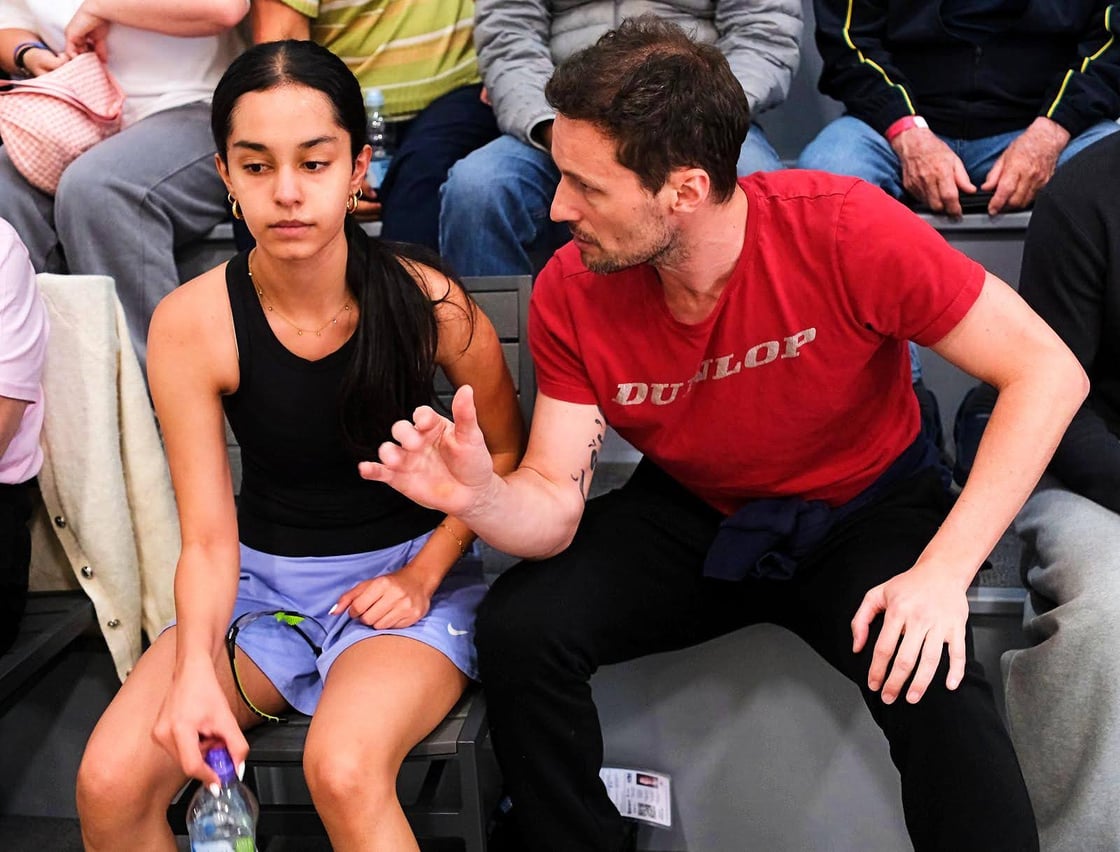 Photo credit: Steve Cubbins
A Brief History of Indian Squash
Before talking more about Anahat specifically, I think it’s important to touch on India’s history in squash, because she’s emerging from a system that has steadily become stronger over the last couple of decades.
Unlike countries such as Egypt or Pakistan, India was never traditionally viewed as one of the absolute powerhouse nations in squash.
However, over time, they’ve built an incredibly solid foundation and have consistently produced high-level professionals on both the men’s and women’s sides of the game.
For me, the player who really helped put Indian squash on the modern map was Saurav Ghosal.
He became the first Indian man to break into the world’s top 10 and was such a huge figure for the sport in India for many years.
Alongside him, Dipika Pallikal and Joshna Chinappa played massive roles in raising the profile of women’s squash in the country.
Both had excellent careers individually, but they also achieved a lot together in doubles competition, particularly at the Commonwealth Games and Asian Games.
More recently, players like Ramit Tandon, Velavan Senthilkumar and Abhay Singh have been putting india on the map, while younger names are starting to emerge behind them too (Veer Chotrani is another big one that comes to mind).
That’s what makes this current period so interesting to me.
It no longer feels like India is producing the occasional standout player; it feels more like they’re building genuine depth across the board.
And, importantly, a lot of these younger players seem fearless.
They’re clearly growing up watching Indian players succeed internationally, which naturally changes expectations and belief levels.
That’s why Anahat Singh’s rise feels significant beyond just her individual results.
 Photo credit: Steve Cubbins
Anahat's Professional Career So Far
Anahat Singh’s rise on the PSA Tour has been one of the more striking developments in the women’s game over the past couple of seasons, and what stands out most is just how quickly she’s gone from a promising junior to a genuine problem for established top-10 players.
At this point, she’s already sitting at her highest ranking (World No.20, as previously mentioned) in the world rankings, which is pretty remarkable when you consider her age and how recently she’s transitioned into the senior circuit full-time.
This season, she's won the JSW Indian Open (beating Hana Moataz in the final), and, the Squash on Fire Open (beating Gina Kennedy in the final), both of which are spectacular wins.
But beyond the titles, it’s the way she’s picking up individual results that really tells the story.
This season in particular feels like an absolutely huge step forward.
At the 2026 El Gouna International, she took a game off World No.1 Hania El Hammamy, which, in isolation, is already a strong indicator of where her level is heading.
But it’s not just the headline moments like that, it’s the consistency she’s starting to show against a wide range of the top 30 players.
She’s picked up wins over experienced PSA Tour players including Hana Moataz, Zaina Mickawy, Gina Kennedy, Sabrina Sobhy, Sana Ibrahim, and Lucy Turmel, which is a really impressive spread of results across different styles and match dynamics.
These aren’t isolated upsets either, they feel more like part of a broader pattern where she’s becoming increasingly comfortable dictating matches at this level.
Even in matches where she hasn’t come out on top, she’s been pushing some of the very best to to the fifth this season.
Both Satomi Watanabe (World No.6) and Tinne Gilis (World No.10) were taken to five games by Anahat, which says a lot about her ability to stay competitive deep into high-pressure situations against elite opposition.
That’s often the biggest jump for young players coming through, moving from occasionally challenging top players to doing it on a regular basis, across multiple events, and in different conditions.
What’s also interesting is how these results are coming across a fairly wide range of tournaments and opponents, rather than being isolated runs at specific events.
It suggests a level of adaptability that’s rare for someone still so early in their professional career.
There’s still a sense that she’s learning how to put these matches away consistently, especially against the very top tier, but the baseline level is already there.
She’s not just competing anymore, she’s actively shaping matches against some of the best players in the world.
And given how quickly she’s closed the gap, it feels like it’s only a matter of time before these close losses start turning into wins on the big stages.
Singh's Style Of Play
What stands out most about Anahat Singh on court is that she already plays with a level of composure and tactical clarity that you don’t usually associate with someone so young.
At 165cm tall (according to the PSA website), she doesn’t rely on physical dominance in the traditional sense.
Instead, she uses a combination of timing, deception, and court awareness to control rallies, often forcing opponents to play at a pace and rhythm that suits her game rather than theirs.
A big part of her effectiveness comes from the fact that she’s incredibly natural and relaxed in the way she strikes the ball.
There’s a looseness to her swing that allows her to disguise shots late, particularly from mid-court positions, which makes her difficult to read when she starts to open up the angles.
You’ll often see her hold the ball just that fraction longer before either playing soft into the front or changing direction entirely.
That deceptive element is also something she’s carried over from her early sporting background in badminton, and it shows in the way she’s comfortable creating angles from positions where most players would simply look to reset the rally.
One of the more interesting aspects of her game is how complete it's starting to look, especially considering her age.
She’s not just an attacking player going for winners whenever possible, she’s actually quite patient in building rallies, especially at the highest level.
When needed, she’ll trade length and stay disciplined, but she always has the ability to inject variation through soft hands and sudden changes of pace.
Movement-wise, she’s also very efficient.
She may not have the biggest physical frame on tour, but she gets into position early and recovers well, which allows her to stay balanced even under pressure.
That balance is key to how she’s able to maintain control against physically stronger or more experienced opponents.
If there’s one area that really defines her style, it’s that blend of control and unpredictability.
She can look completely settled in a rally, then suddenly take it short or reverse the direction and immediately shift the pressure onto her opponent.
It’s still a developing game in some respects, particularly in terms of consistency and when to choose the right attacking moments, but the foundation is already there.
And right now, that mix of touch, deception, and calm decision-making is what makes her such a difficult player or opponents to adapt to.
 Photo credit: Steve Cubbins
Close Match Ups and Rivalries
Given how early Anahat Singh is in her professional journey, it’s probably no surprise that she doesn’t yet have any real rivalries in the traditional sense.
That usually only starts to develop once players are meeting repeatedly in latter stages of major events, and she’s only just beginning to consistently operate at that level.
That said, we’re already starting to see the early signs of certain matchups becoming meaningful.
A good example are her wins over both Sana Ibrahim (World No.19) and Sabrina Sobhy (World No.18).
Both matches we're close.
The win over Sana Ibrahim was a tight 3-2 battle, where Anahat had to dig herself out of a difficult position from 2-0 down before eventually turning the match around.
That kind of result says a lot, not just about level, but about her ability to problem-solve mid-match against a player of a similar ranking.
Against Sabrina Sobhy, she came through 3-1.
Sobhy has been a regular feature around the top end of the game for years, so to control that match over four games is another strong indicator that Anahat is already comfortable competing with established PSA Tour names.
What’s also interesting is that, beyond those two results, we haven’t yet seen a large sample size of matches against the other players clustered around the rest of the top 20.
She does have that big win over Gina Kennedy (World No.9) at the Squash on Fire Open too, but, while the early signs are encouraging, there’s still a bit of a gap in terms of repeated encounters that would naturally develop into proper rivalries.
In many ways, that feels like the next stage of her progression.
What's Next?
Building on those early wins over players just above her in the rankings, the next stage of Anahat Singh’s progression feels pretty clear, even if the usual response from professionals at this point would be that rankings don’t matter.
And while that’s absolutely the right mindset to have, it’s still hard not to look at the next logical steps in front of her.
The immediate challenge now is consistency against that next tier of players sitting in and around the top 15-25 bracket.
She’s already shown she can beat names like Sana Ibrahim and Sabrina Sobhy, but the real test is whether she can start doing that week after week, across different conditions and pressure situations, rather than as one-off results.
From there, I really want to see her up against players like Farida Mohamed, Jasmine Hutton, Salma Hany, and Nada Abbas. These are the types of matches that really tend to define whether a player is ready to make the jump from breakthrough talent to genuine top-10 contender.
If Anahat can start consistently getting results against that group, it feels like she’d be putting herself firmly on track to break into the top 10 conversation.
Given how quickly she’s adapted so far, it wouldn’t be surprising to see that kind of progression come sooner rather than later, potentially even by the end of next season if things continue on this trajectory.
What makes her situation particularly interesting is that she’s already shown she can compete with established top-10 players in short bursts.
Those tight matches against Satomi Watanabe and Tinne Gilis are a good example of how close she can get in certain matchups.
The next step is turning those near-misses into wins, especially on bigger stages.
That’s usually the point where players start to shift from being promising to being genuinely dangerous for anyone in the draw.
If she can start adding a few statement wins against top-10 opposition along the way, it would accelerate that process even further.
At that level, it’s often not just about ability, but belief, knowing you’ve already done it before against those opponents changes the way you walk into those matches.
Right now, everything about her trajectory suggests she’s heading in that direction.
The tools are clearly there, the results are starting to stack up, and the gap between her and the established top names is already looking smaller than it should be at this stage of her career.
So, in summary, I think we'll be seeing big things from Anahat next season, watch this space!
This article was taken from our On The 'T' Newsletter, if you're interested in receiving more content like this, please feel free to sign up using the subscribe section located at the bottom left of this page (or underneath the article if you're on mobile), thanks!


