
If you’ve followed Control the ‘T’ Sports for a while and kept up with our content, you’ll already be familiar with Nicole Bunyan.
Nicole has been a member of Team CT for several years now, and we’ve loved following her journey as she continues to compete on the PSA World Tour.
From her early days playing junior squash in Canada, to her time at Princeton University, and now travelling the world as a professional athlete, Nicole’s journey has been incredibly interesting.
Alongside her playing career, Nicole is also the founder of Squashletic, a certified personal trainer and nutrition coach, and a regular voice on SquashTV commentary, giving her a unique perspective on the game both on and off the court.
We caught up with Nicole to discuss life on tour, the evolution of the women’s game, physical preparation, coaching, and the lessons she’s learned throughout her career.
Let's dive into the interview ...
Background & Journey on Tour
How did you first get into squash, and what was your path from junior squash in Canada to competing on the PSA World Tour?
My parents played recreationally (and still do, to this day!), so I grew up hanging around the squash courts before I picked up the game. I got into squash gradually, playing once a week when I was 10.
Then twice a week the following year, and then 3-4x/week when I was about 13. It was at this time I had to make a choice to pursue squash as my priority sport rather than soccer, which had been my main sport for my earlier years.
After junior squash, I was recruited to play at Princeton, where I was exposed to greater depth of play. All throughout my college years, it didn’t really occur to me to play pro, as it wasn’t a common pathway for college athletes.
Most squash players went on to desk jobs after college. However, I had a good final season, and encouraged by John Musto (the pro at the Princeton Club NY I met upon moving to NYC), I decided to try my hand at some pro tournaments.
At what point did you realise you could compete at the top international level?
Winning matches early on in my pro career showed me I could play and compete. However, for much of my career I feel I’ve had to play catch up on pretty much all fronts: tactically, technically, mentally, professionally, and movement-wise.
So I suppose I realised early on that I could compete, but winning and truly feeling like I belonged there took a few more years.
You studied at Princeton and competed as an All-American, how did US college squash shape you as a professional athlete?
I learned a lot about how to become a better competitor by playing US college squash at Princeton. It’s incredibly motivating to always have something else to play for besides yourself, and I thrived in that environment.
I also honed in on my physical strengths as a player, and vowed to always be the fittest player on the court. This alone got me to Top 2/3 on the ladder and got me through a lot of matches.
Life on the PSA World Tour
What does a typical season look like for you in terms of travel, training, and competition?
A lot of travel! This year in particular has been extremely busy. From January to April, I didn’t spend more than 5 consecutive days at home. That definitely took its toll, and I’ll be a lot more selective with my travel going forwards, because it does accumulate fatigue.
The season is quite long, from September to June, and we usually have the Pan Am Championships in August to prepare for as well.
Over the past couple of years, I’ve elected to take a lighter month from tournaments (either November or December, or February) depending on the schedule to allow myself to just train and have a break from competition. That’s been really helpful for the longevity of my season and also for my body.
What are the biggest challenges of life on tour that people don’t really see from the outside?
Probably the finances. Deciding to take on a coaching session to pay the bills even though it will detract from your energy for training that day. Or, for some players who play the leagues/exhibitions, trying to squeeze those in and around tournaments even though they might prefer to rest and train properly.
Financial sponsors are not easy to come by as a squash player, so many players either rely on coaching for income, or cut corners wherever possible. I am fortunate to have my business, Squashletic, but even I have to be mindful of not taking on too much (although the opportunities are terrific), because it is still time and energy consuming.
If you look at the top players, they are not splitting their time. They are 100% all in on training, resting, and competition.
How has the women’s PSA Tour changed since you first joined it?
It’s improved tremendously. The game has become so much more physical, and the depth is greater as well. I would say 40 in the world 10 years ago is the equivalent of 70 now. The professionalism across both men’s and women’s tours is a lot higher, and we have increased prize money to thank for that!
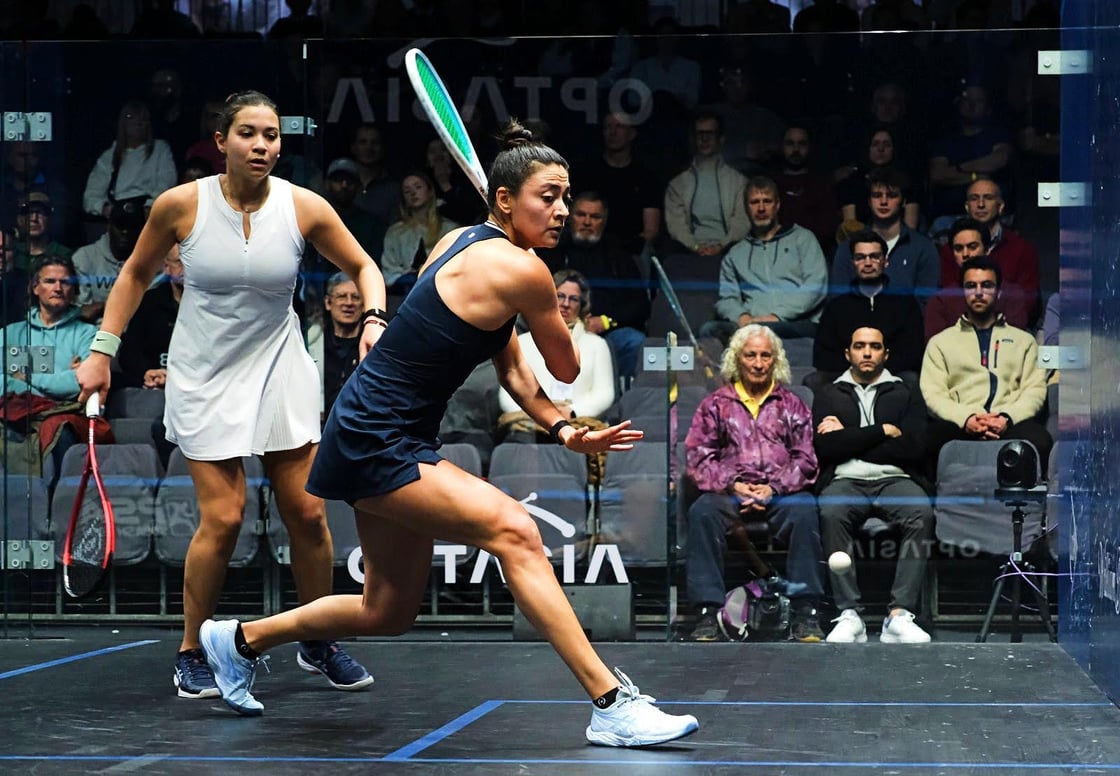
Image credit: Steve Cubbins
Squash Movement & Physical Development
You’re also a certified personal trainer and nutrition coach. How much of your squash performance comes down to physical preparation vs on-court skill?
I focus on both heavily. I need to always work on my fitness and movement because I rely on them as strengths, but I am continuously working on my ball control because it was a relatively weaker part of my game.
Growing up, I spent 80% of my time working on the physical side, whether that was on or off court, so I’ve had to make up a lot of ground technically (and therefore tactically).
Have you changed anything in your training or mindset over the last few years that has had a big impact on your results?
Loads! Every time I have a loss I come away with something to change, whether it’s a major mindset shift, or a technical/tactical tweak.
One big thing I changed in my training in the pros was focusing more on ghosting. This had a really big impact in being able to actually translate my fitness into being more physically dominant on court.
In addition to improving speed and fitness, I became a more efficient mover, which also helped me control the game better.
Squashletic & Coaching
Please tell us a bit about Squashletic, how it came about, and how it’s evolved since launching?
Squashletic started during Covid! I was considering business school but didn’t know much about business and if I would even enjoy “business”, so I decided to start one. With it being lockdown, an online business made the most sense.
I considered my areas of expertise, squash, strength & conditioning. I’ve always had a passion for health & fitness, so I really enjoyed creating content to help squash players with strength & conditioning.
I ended up designing an app where people can subscribe and access a library of workouts, programs, and resources (like Peloton for squash players), and also take on 1:1 clients for customized programming.
It’s a great way to help people in a way which perfectly suits my strengths and areas of expertise, while being able to have the flexibility and time to dedicate to my training and PSA competitions.
Through Squashletic, what are the most common physical weaknesses you see in club players?
I think most club players could improve their flexibility & mobility, as well as their on-court movement. I know this stuff isn’t all that fun to work on, but it makes an immediate difference to how you feel on court.
All of this can be incorporated into a better warm-up, which will not only help your body feel better, but also help you get more out of your session. It does take some discipline to get to the courts 15–30 minutes early to do this, but the benefits are worth it in my opinion (and my clients can confirm this!).
How do you balance creating training content with your own professional playing career?
I’ve tried to be a lot more efficient with content creation, and in busy competition periods, I completely lay off social media from a work perspective. I stick to the bare minimum, which means serving my existing clients.
Content creation and marketing takes a lot of brain power, which I’d rather save for the court! (I learned this the hard way.)
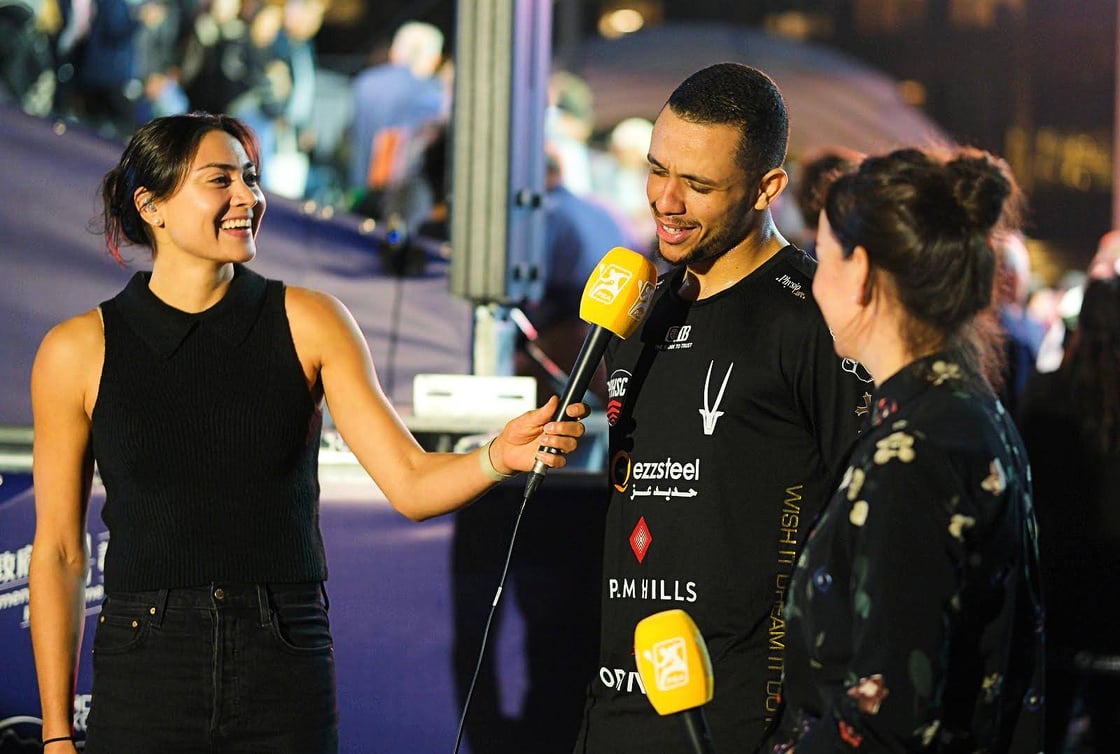
Image credit: Steve Cubbins
SquashTV Commentary & Media Work
You also do live commentary for SquashTV at major PSA events, how did that opportunity first come about?
Yes I do! It all started when I was asked to fill in as an MC at World Champs back in 2022. From there, I did a little more MC’ing, and then was asked if I’d like to commentate.
As the SquashTV production has evolved, I’ve had the opportunity to grow and develop other skills like presenting or interviews.
How do you prepare for commentary on matches involving top players?
I watch a lot of squash, and spend a lot of time with squash players, even when I’m not at the tournaments, so I naturally stay up to speed with what’s happening, whether that’s injuries, coaching changes, or life updates.
Plus, I make sure to write notes and do my statistical research before matches so I can pull out informative and important facts during the games themselves. Anecdotes and stories, however, usually pop into your head on the spot!
Do you ever find yourself spotting tactical patterns or movement details on commentary that you might not notice when you’re actually competing?
I find it a lot easier to spot patterns and details when on the court, and not wrapped up in my own head & abilities. It can be hard to remember to “zoom out” when playing, and is definitely a skill I am working on.
Squash Insights & the Modern Game
Are there any emerging players you think are particularly exciting to watch?
Always. I think Marina Stefanoni’s rise over this past season has been very interesting and I am curious to see how she evolves to push into the Top 10.
Everyone has been talking about Lauren Baltayan, and she definitely has a lot of potential to push high quickly over the next couple of years. One of the more unique players to watch is Anahat Singh, with a natural attacking style that is very disruptive to play against.
She is off to Harvard in the fall, so we may not see as much of her in tournaments as she balances college squash with academics, but I don’t see her level dropping during this time (she may just not accelerate as quickly through the ranks due to her commitments).
What do you think will be the biggest change in professional squash over the next 5–10 years?
My hope is we see squash secure a major broadcast deal, which will bring more money and visibility to the sport. The SquashTV product is excellent now; however, it’s “hidden” behind closed doors. We need to get it out to the masses!
Final Thoughts
What has been your proudest moment on the PSA Tour so far?
I think a lot of my proudest moments have actually come from Pan Ams, Commonwealth, or National events where I’m representing Canada. Medalling with the support of your team and country brings me the most pride.
If you could give one piece of advice to your younger self at the start of your professional career, what would it be?
Keep going, and keep trying everything, it gets better.
This article was taken from our On The 'T' Newsletter, if you're interested in receiving more content like this, please feel free to sign up using the subscribe section located at the bottom left of this page (or underneath the article if you're on mobile), thanks!


