
Despite the reputation squash has as a fairly niche sport, there's no denying that professional squash has definitely grown over the past decade.
The production value is higher. The events feel bigger. The PSA calendar is more structured. Prize money parity between men and women is now a reality.
And, of course, the sport has finally secured its place at the 2028 Los Angeles Olympic Games.
On the surface, everything looks like it’s moving in the right direction.
But behind the glass courts and Platinum finals, there’s a question that doesn’t get discussed often enough:
Is professional squash actually financially sustainable?
This isn’t meant to be a doom-and-gloom piece, and it is not intended to undermine the progress that’s clearly been made. Instead, it’s a look at the economic realities of the sport, the numbers, the costs, the structural challenges, and the potential opportunities that lie ahead.
Because while we all celebrate the success of the very top players, there’s a much wider ecosystem beneath them that deserves attention too.
Just an FYI before we dive in, this is a topic I've been researching for a year or two now, and it's actually quite tricky to get a lot of the data I was looking for on the squash front.
For this reason, some of the numbers may be a little older, but I doubt that the financial side of things has changed too drastically in the past few years, and I believe that the main messages of this article ring very true.
Anyway, let's talk about the economics of professional squash.
The Prize Money Reality
The PSA has made commendable strides in increasing prize money over the past decade.
By the 2022-2023 season, the tour distributed approximately $8.95 million across its tournaments.
Top players such as Ali Farag and Nouran Gohar have earned over $275,000 in prize money during strong seasons.
The introduction of prize money parity between men and women marked a significant milestone for the sport, and the restructuring of the tour into World, Challenger, Satellite and Federation Events has created clearer competitive pathways.
These are genuine achievements.
However, prize money in squash, like many individual sports, is heavily weighted toward the top performers.
An early-round exit at a major PSA event can earn a player less than $500.
I'm good friends with a fair few pro squash players from England, and they've echoed numbers in this ballpark on a number of occasions when I've spoken with them.
Smaller tournaments, with prize pools ranging from $10,000 to $20,000, often pay a semi-finalist around $1,500.
Once travel and accommodation costs are deducted, those earnings can disappear quickly.
When compared to tennis, the disparity becomes stark. In 2023, Novak Djokovic earned over $12.5 million in prize money.
Meanwhile, the 100th-ranked ATP player earned more than $200,000, roughly on par with squash’s top earners.
Even within Olympic sports such as badminton and table tennis, world championship prize pools frequently exceed those seen in squash.
The 2023 Badminton World Championships offered a $1.5 million purse compared to squash’s $500,000 equivalent.
It’s important to note that financial imbalance isn’t unique to squash. Conor Niland’s book The Racket highlights the precarious economics of lower-tier tennis.
I will note that I'm not a huge reader of books... which is why I listened to The Racket as an audiobook! It was recommended by a couple of people and I thought I'd give it a look.
I would now highly recommend it too; it's pretty eye-opening and definitely does a great job of highlighting the plights of lower-level sports pros trying to work their way up the rankings, even in sports like tennis that are often seen as well-paying.
Anyway, across seven years on the ATP Tour, Niland earned approximately $250,000 in prize money. After accounting for travel, coaching and living expenses, he finished his career with almost no savings.
Professional sport is often sustainable only for a small percentage of athletes. Squash simply reflects that broader reality, but perhaps with fewer financial buffers than some of its counterparts.
The Cost of Competing on Tour
The cost of competing on the tour is high.
A full-time PSA professional can easily face annual expenses exceeding $30,000-$40,000 USD.
Flights across continents form the bulk of that figure.
The PSA calendar is global, and ranking progression often requires players to compete wherever opportunities arise, North America one month, Europe the next, Asia shortly after.
Add to that visas, accommodation, entry fees, insurance, physiotherapy, strength and conditioning support, and coaching travel costs, and the financial burden grows quickly.
Unlike team sports, where clubs often cover travel and support staff, individual squash players typically shoulder these costs themselves.
Sponsorship can alleviate some of this strain, but meaningful financial backing is usually reserved for higher-ranked players. Those outside the top 50 often receive equipment support rather than substantial monetary sponsorship.
Different nations offer varying levels of support through their governing bodies.
Some federations provide stipends or funding linked to rankings and performance.
Others operate with limited budgets and must prioritize grassroots development or participation initiatives over elite athlete funding.
I'm not too sure what the situation with this is in Canada, but I believe that England are actually quite good at assisting with this side of professional squash.
However, comparatively, sports like triathlon demonstrate how centralized funding models can support athletes beyond the very top tier.
British Triathlon, backed by UK Sport, offers centralized training facilities, coaching access, physiotherapy, and financial support to athletes on Olympic pathways.
These structures create greater career stability and allow athletes to focus more fully on performance.
Squash, lacking Olympic history until now and operating with lower global visibility, has not enjoyed comparable systemic funding.
Without reform, there is a risk that professional squash becomes increasingly accessible only to those with independent financial means.
This dynamic can limit diversity, restrict regional representation, and create barriers for talented players from developing nations who may lack sponsorship networks or institutional backing.
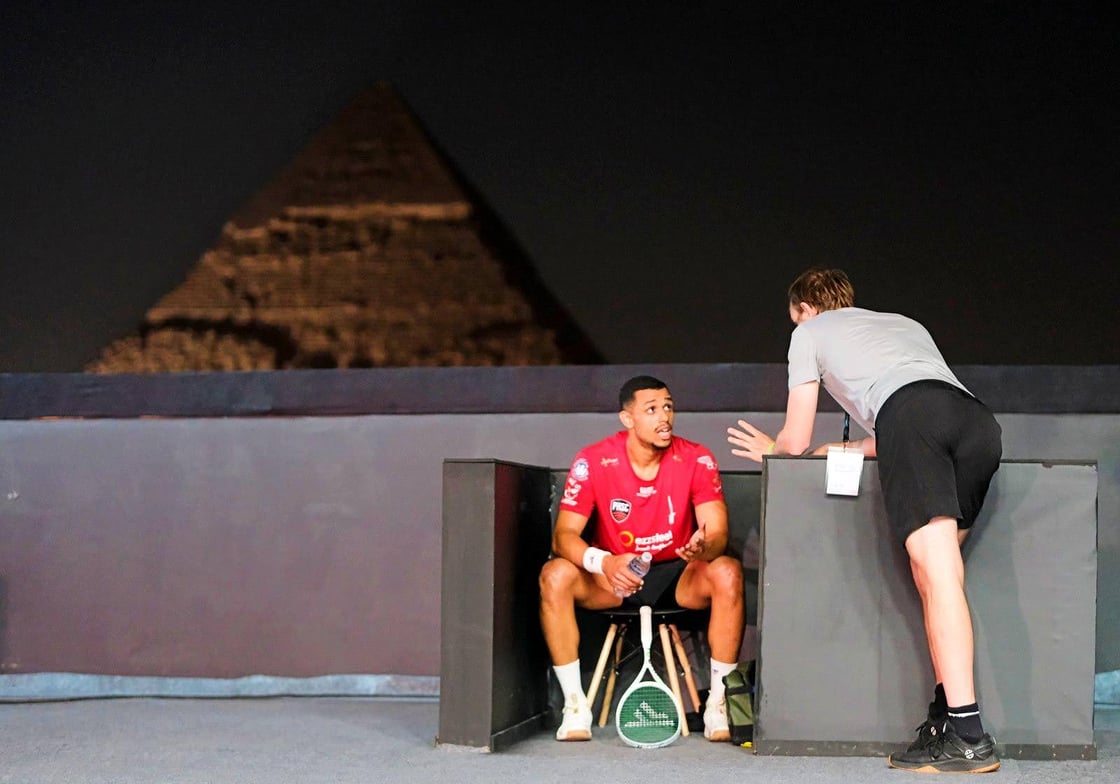 Photo credit: Steve Cubbins
Sponsorship and Media Visibility
Sponsorship remains one of the most significant limiting factors in squash’s economic ecosystem.
For individual athletes, sponsorship typically falls into two categories. The first involves equipment and apparel brands closely tied to the sport, companies such as Dunlop, Tecnifibre, Harrow and Head.
These partnerships often provide racquets, shoes, strings, clothing and sometimes financial support.
However, the exact monetary details are rarely public, and for many players, these agreements primarily offset equipment costs rather than generate substantial income.
The second category, mainstream, cross-industry sponsorship, is far rarer in squash.
Unlike tennis or golf, squash lacks widely recognized global superstars who transcend the sport itself.
Even the game’s biggest names are primarily known within the squash community.
Without broad public recognition, attracting major commercial sponsorships from industries such as finance, technology, or lifestyle brands becomes considerably more difficult.
At the event level, however, there are encouraging signs. The PSA’s partnership with Castore represented a step toward greater professional branding and commercial alignment.
Tournament presentation has improved significantly, and SquashTV provides high-quality streaming coverage for dedicated fans.
Yet global reach remains limited compared to sports with established mainstream broadcasting deals.
Tennis enjoys international television exposure that elevates even mid-ranked players into public consciousness. This visibility translates directly into sponsorship value.
Squash’s challenge lies not in its quality as a sporting product, the athleticism and drama are undeniable, but in its limited mainstream exposure.
There are potential solutions.
Enhanced storytelling, behind-the-scenes documentaries, player-focused content and creative broadcast innovations could broaden appeal.
The PSA has already taken steps in this direction with documentary projects and increased social media presence.
Humanizing athletes and sharing their journeys can deepen fan engagement and make the sport more relatable to new audiences.
Ultimately, sponsorship growth depends on visibility, and visibility depends on strategic marketing investment.
Life After Squash
The professional lifespan of an athlete is inherently short. For squash players, the post-retirement transition presents additional challenges.
Tennis has established pension schemes through the ATP and WTA, offering financial support to players who meet participation criteria.
These structures provide a long-term safety net and acknowledge the limited earning window of professional athletes.
Squash currently lacks an equivalent system (or at least I think it does, I'm not 100% certain on this so maybe someone can enlighten me).
Many former players transition into coaching, often relocating to high-demand regions such as London, New York or Cairo.
Others pursue roles in commentary, administration or ambassadorial positions within the sport. However, these opportunities are relatively limited compared to larger sports with broader commercial ecosystems.
There are signs of progress. I believe that the PSA Foundation has introduced workshops focused on financial literacy, mental health support and career planning, for example.
These initiatives recognize that athlete welfare extends beyond prize money.
Further steps could include partnerships with universities to offer flexible educational pathways, mentorship programmes pairing retiring players with professionals in business or media, and even the establishment of a modest retirement fund supported by tournament revenues and sponsorship contributions.
Providing structured career transition support would not only assist retiring professionals but also make squash a more attractive long-term prospect for young talent, considering the professional pathway.

Photo credit: Steve Cubbins
The Olympic Opportunity
The inclusion of squash in the 2028 Los Angeles Olympic Games represents a historic breakthrough.
For decades, the sport lobbied for Olympic recognition. Now that the opportunity has arrived.
Olympic inclusion has historically transformed niche sports. Badminton, since joining the Games in 1992, has grown significantly in global participation and commercial backing.
Table tennis experienced a similar expansion following its 1988 debut. More recently, skateboarding and surfing saw substantial increases in visibility and sponsorship after their Olympic introductions.
However, Olympic impact does not occur automatically.
Sustained growth requires strategic planning.
Investment in grassroots infrastructure, improved accessibility to courts, enhanced broadcasting partnerships, and compelling athlete storytelling will be essential to capitalize on the Olympic spotlight.
Squash also faces unique broadcast challenges. Its enclosed court and rapid pace can be difficult for unfamiliar audiences to follow.
Continued innovation in camera angles, graphics and commentary clarity will be important in making the sport accessible to new viewers.
If leveraged effectively, the Olympics could unlock increased funding, sponsorship interest and participation growth, particularly in emerging markets such as the United States and India.
But the Games alone will not solve existing financial disparities.
They represent an opportunity, not a guarantee.
A Blueprint for a More Sustainable Future
Addressing the economic challenges within professional squash requires coordinated effort across governing bodies, sponsors and players.
Increasing prize money at smaller events would provide immediate relief for lower-ranked professionals.
However, structural mechanisms such as revenue-sharing agreements, minimum prize guarantees or redistribution models from major tournaments could create a more equitable system.
Sponsorship diversification beyond traditional equipment brands is also crucial. Positioning squash as dynamic, modern and globally inclusive can attract interest from technology, health, and lifestyle sectors.
Demonstrating measurable audience growth and digital engagement metrics will strengthen the case for commercial investment.
Grassroots development should be viewed as both a social and economic strategy.
Expanding public court access and school programmes builds participation pipelines that ultimately strengthen the professional game.
Egypt’s dominance illustrates the long-term impact of sustained youth development investment.
Athlete support systems, including education partnerships, mentorship initiatives and career transition programmes, can provide greater long-term stability.
Perhaps most importantly, transparent data-sharing on audience demographics, player earnings trends and sponsorship returns could enhance investor confidence and attract sustainable partnerships.
Final Thoughts
Professional squash is undoubtedly progressing.
Prize money has increased. The tour is more structured. The Olympics await.
Yet beneath the visible growth, financial sustainability remains a significant challenge for many players outside the very top tier.
The sport stands at a pivotal moment. With strategic investment, collaborative leadership and thoughtful reform, squash can build a more equitable and financially viable professional ecosystem.
The 2028 Olympics may prove to be a turning point.
What happens next will determine whether that opportunity translates into lasting change.
Lastly, I want to note that this has been a really interesting topic to research and write about; however, the more I looked into it, the less I realized I knew about it.
So, if any of you have any insights or things to add, please feel free to get in touch and let me know about them!
When I come to put this on our blog page (which I usually do in within a couple of weeks after this email goes out), I may be able to include your thoughts.
Thanks for reading!
This article was taken from our On The 'T' Newsletter, if you're interested in receiving more content like this, please feel free to sign up using the subscribe section located at the bottom left of this page (or underneath the article if you're on mobile), thanks!


