
Artificial intelligence is beginning to transform the way sport is analyzed, coached, and experienced, and one of the companies pushing those boundaries is Motion Dynamics.
Founded by former pro squash player Stuart MacGregor and Dr. Diar Abdlkarim, Motion Dynamics is developing cutting-edge markerless motion capture technology capable of analyzing athletes in real time using nothing more than video.
From helping broadcasters tell richer stories to providing coaches and players with deeper performance insights, the technology has the potential to change the way we understand movement in sport.
Stuart was kind enough to take part in an interview about his journey from the PSA Squash Tour to founding Motion Dynamics, as well as the challenges of bringing AI to elite sport, and why squash could be the perfect proving ground for the next generation of sports analytics.
Let's dive in ...
Background & Origin Story
Can you start by telling us a bit about your background as both a former athlete and someone working in data and AI?
I reached 119 in the PSA world rankings as a pro and also represented England at the junior level.
Through my experience in training and competition, I built a strong understanding of what it takes to perform at the top level of sport. Competing against the best in the world, and through my interest in technology, I began to see the potential for how it could be used not only to help elite athletes, but also anyone who participates in sport, to improve performance, prevent injury, and enhance the entertainment value of sport.
I have previously worked as a data engineer in the sports industry, looking at how organisations use data and how unreliable data can impact business decisions. With my background in computer science, work in motion capture during my master’s, and meeting my co-founder, who is an expert in motion capture and previously worked at Meta, we created Motion Dynamics.
The goal was to build technology using cameras to provide valuable data and feedback to the sports industry, bringing both entertainment and meaningful insights for players to help prolong careers and improve enjoyment of sport.
How did your experience studying Human Biology and Computer Science shape the way you think about performance in sport?
Studying human biology gave me a deep understanding of biomechanics, how the body works, and the importance of proper movement to prevent injury and optimise performance.
My master’s in computer science gave me insight into the potential of technology, and how this can be fused with biomechanics to improve performance in sport.
Was there a specific moment when you realized you wanted to build Motion Dynamics?
We test out motion capture algorithms in our lab, analysing my own technique and comparing it to the pros. The data I got from that was exactly what my coach had been telling me. I thought I was doing it and improving it, but seeing the raw data made me realise I wasn’t making the gains I thought I was.
When I saw this, Diar (my co-founder) and I wanted to bring this technology to all who play sport, essentially bringing expensive, inaccessible lab insights into real-world environments and making it accessible to everyone who’s passionate about their sport and performance.
What Motion Dynamics Actually Does
How would you explain what the platform actually does in simple terms, and what problem in sport were you trying to solve when you started building it?
At its simplest, we turn ordinary video into a clear readout of how the game is moving: the players and the ball. You upload footage from a broadcast, a phone, a fixed camera, whatever you’ve got, and the system tracks player movement and ball trajectory across the court. On top of that, it adds a deeper layer on how each athlete moves, such as weight transfer, how the racket arm loads, and where movement is efficient or costing time.
Crucially, the tracking and insights run in real time, live during the rally. For a broadcaster, analysis that arrives the next day is not as valuable as real-time in-play analysis. Analysis that arrives as the point unfolds is invaluable for commentators, spectators and players, and that’s something squash simply hasn’t had before.
The bigger problem we set out to solve is that serious movement analysis used to be locked inside a lab, with markers, suits, and a controlled space. That’s useless for a real rally at full speed. We wanted that lab-grade rigour from ordinary match footage, with nothing attached to the player.
Raw data was never the goal. Anyone can produce graphs. The hard part is turning them into something you can act on, so a coach knows what to change, a player understands why a movement is costing them, and a broadcaster gets a story the audience can follow.
On your website, Motion Dynamics is described it as “AI-powered motion intelligence” - what does that mean in practical terms for a coach or athlete?
The intelligence is the layer that turns those numbers into something useful, telling you what the movement actually means and what to do about it.
For a coach, that’s the difference between a spreadsheet and a clear answer.
Instead of staring at joint angles, you learn that a player’s lunge has lost depth over the last three months, or that she’s compensating with the shoulder instead of rotating through the hip, and you know exactly what to work on in the next session.
For an athlete, it means understanding the specific reason a movement feels heavy or slow, and seeing whether a technical change is genuinely bedding in over a season. For a business or broadcaster, it’s insight that tells a story rather than a wall of statistics.
That’s the whole point of motion intelligence. The data is just the raw material. The value is in the insight we build on top of it the part a coach, player or broadcaster can actually act on.
 Image credit: Steve Cubbins
AI, Motion Capture & Performance
How accurate is modern markerless motion tracking, and how quickly is that technology improving?
This is actually the big unanswered question in the space, and it’s one we are tackling head on. The marker-based systems like OptiTrack and Qualisys are the ground truth today, they sit at sub-millimetre accuracy and have been trusted for years. Markerless is the newer approach, and the honest answer is that no one has properly measured it against those ground truth systems yet, especially in sport.
A big reason for that comes down to what these markerless models are trained on. The data they learn from is general human movement, people doing everyday tasks like walking, sitting, picking things up. It is not athletes moving at full speed under pressure. So even though the models are impressive, we do not actually know how well they hold up for sport, where the movements are explosive, extreme, and nothing like what the model was trained on.
People throw around accuracy numbers, but that proper comparison against ground truth on real sporting movement just hasn’t been done. That is exactly the gap we are closing with our golf work, building a system that measures markerless directly against the industry standard so we know how accurate it really is instead of assuming.
What I can say is markerless is improving faster than marker-based ever did, because it rides on AI and computer vision research that moves every few months, along with cameras and compute getting cheaper and better. And it removes all the problems that made marker-based useless outside a lab, no suits, no markers dropping out when someone moves fast, no long mark-up and calibration.
So it's less about one accuracy number today and more about the direction of travel. Our job is to prove exactly how good it is on real sporting movement, so we only ever bring our clients data we know we can trust.
In your view, what are the biggest inefficiencies or blind spots in how athletes are currently analyzed?
Squash is indoor, which makes GPS tracking unavailable. We solve that through computer vision and AI.
Current tracking does not allow for a deeper understanding of athletes. It can capture movements, patterns, speeds etc, i.e. it only captures positional information.
What is currently lacking is real biomechanical data in real-world competitions.
A huge issue we have found across all sports is that athletes do not perform the same in training and lab conditions as they do in real competition. The insights from this become extremely valuable, not just for how they train, but also how they compete, by understanding biomechanical movements and how athletes actually move under pressure.
Another question to answer is whether training actually increases performance, or whether it only seems like players are improving because their gym numbers or fitness tests are going up. For example, does squatting a PB actually improve movement and speed back to the T, or do sprint tests reliably show that the athlete is improving speed on court?

Squash-Specific Applications
You’ve worked with organizations like SquashTV and the PSA - what does Motion Dynamics bring specifically to squash?
Squash’s biggest challenge is bringing entertainment value to the audience and showcasing the incredible talent and complexity the sport can bring. The Squash TV team do a great job of bringing squash to life with their production and direction, and Motion Dynamics is building on top of this.
We bring insights, visuals, and data that add value to the audience, giving a better understanding of the sport and demonstrating the athleticism and skill the players have. Ultimately, it helps keep fans more engaged and brings new fans into the sport.
What aspects of squash are the most “data-rich” or easiest to analyze from a motion perspective?
Nothing has been easy about squash. It has been the most challenging sport to solve so far, two players in the same space, maintaining tracking for both players when occlusion is happening throughout the entire match, and doing this without data leaking between the players. A very small, fast-moving ball was also extremely challenging to track, and then turning all of that into valuable, insightful data.
Distances covered, speed, and acceleration metrics are the easiest to calculate from this. In the British Open, some players were covering 3.5km per match, and that is 3.5km of high-intensity lunges. Across six days of a tournament, this adds up, and we can start to form a story for future matches using this data.
Shot count and performance data, e.g. player winners and errors, is also tracked, giving unique insights into playing styles.
By analysing players’ biomechanics, we can identify injury risks and inefficiencies in movement, and feed this back to players to help inform their training.
The data from this is extremely rich, and we can extract almost anything from it by creating the 3D environment (see image) from one angle in real time. Now it’s all about finding what metrics tell the most interesting story, and what data becomes valuable to different audiences, e.g. fans, commentators, and players.
Valuable Squash Data
When you analyse a professional squash match, what are some of the most interesting patterns that emerge from the data?
This is such a great question.
The important thing to understand is that data doesn’t just appear, we need to purposely look for it, and that became clear at the British Open when we covered the matches there.
Our next steps in squash are focused on answering this exact question: what data actually reveals the most interesting patterns that can bring value to fans, broadcasters, and players?
Knowing squash on a deep level, and using everything I’ve learnt throughout my career on tour, will help us identify that data and bring out the most meaningful insights for the sport.
I think my answers below cover what was interesting about the data.
Have you discovered anything about elite squash movement that surprised even you?
The biggest surprise was how similar the distance covered in a rally was between players. We thought the winning or more dominant player would move significantly less than their opponent, but we actually found that players moved very similar distances even when one of them was getting dominated.
Another surprising insight was which players moved the fastest. We expected top players like Joel Makin, Paul Coll, and Hania El Hammamy to be at the top for fastest movements (i.e. top speed), but we actually found other players reaching higher top speeds.
When we looked deeper, we realised those top players actually accelerate the fastest, and therefore don’t reach those top speeds because they cut balls off early and don’t end up doing full court sprints. So the players who have more ground to cover (less ball control) end up having more space to reach those higher top speeds.
Which PSA players have movement characteristics that stand out when viewed through a data-driven lens?
Diego Elias was one of the most interesting players. His matches were the only matches where his opponent moved significantly more than he did.
He reads the game extremely well, moves very efficiently, and controls the ball in a way that moves his opponents around the court and tires them out. Even in his match against Mostafa Asal at the British Open, Asal was covering more ground than he was.
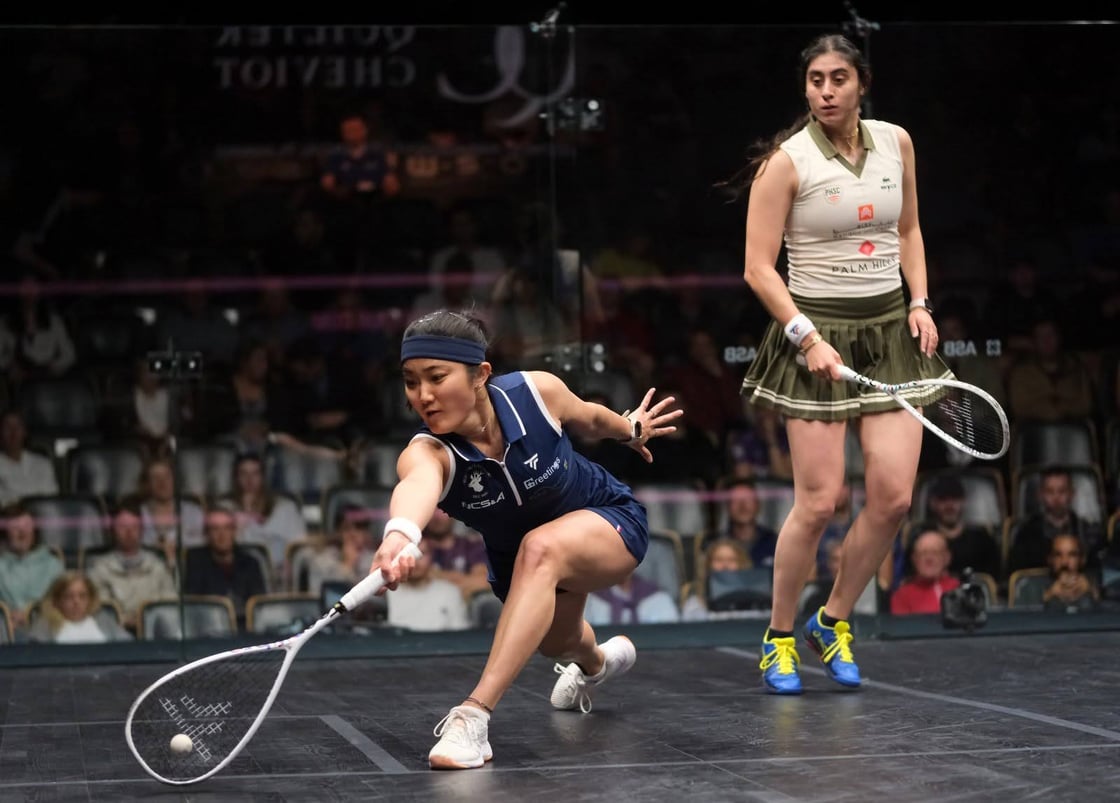 Image credit: Steve Cubbins
Broader Sport Applications
Which sport (outside squash) has been most interesting to apply your system to and why?
Recently we have been working in golf. An unanswered question in the world of markerless motion capture is: “how accurate is markerless motion capture compared to the ground truth systems currently used?”
Systems like OptiTrack and Qualisys are the industry standard today, marking up athletes in a motion capture lab and capturing their movement. This has never properly been compared to markerless approaches, and through working closely with professional golf coaches, we've been able to build a system that accurately compares markerless systems to the industry standard.
The marker-based systems bring their own issues as well. Marker data can become invisible or get lost in movement, and it takes a long time to mark someone up correctly and calibrate the cameras to accurately track them. Markerless systems solve these issues, and we are researching how accurate they actually are so we know we are bringing valuable, reliable, and accurate data to our clients.
We are also focusing on cricket and tennis. The lab technology I’ve just spoken about brings a lot of value, but only to elite players. We want to bring the insights and benefits motion capture can provide to everyone who is passionate about their sport, focusing on grassroots and club level as well.
How transferable are insights between sports like squash, golf, and tennis?
Each sport has its own challenges, and its own ideal techniques, strategy, and the type of information that can be extracted from it.
We’ve developed the foundational technology and pipelines to bring this to any sport, but the focus is always on how that sport is actually played, and what is genuinely useful for it.
We work collaboratively with experts in each sport to make sure we’re surfacing the most useful and engaging information.
Personal & Vision
What has been the most rewarding project or moment since founding Motion Dynamics?
The British Open was a huge one. Seeing our tech run live on matches at one of the biggest tournaments in the sport, tracking two players and the ball in real time through a full match, and actually producing data that told a story, after everything it took to solve squash, was incredibly rewarding.
Outside of squash itself, speaking at the AI Future Tech Forum was a real highlight. Getting to share what we are building with that kind of audience, and having people genuinely interested in where this technology is going, meant a lot.
The Pitch Up Competition was another big milestone for us. We placed in the top 8 out of 66 companies, which was real validation that what we are building matters to people beyond just the sport, and that the vision is landing.
What’s been the hardest technical or business challenge you’ve faced so far?
Solving real-time analytics, without question. Just being able to extract data out of sport automatically is valuable on its own, but doing it live, as the rally is unfolding, is a completely different challenge.
You have no second chances, no going back and cleaning it up afterwards, it has to be accurate the moment it happens. Tracking two players and a tiny, fast-moving ball in the same space, holding that tracking through occlusion without the data leaking between players, and turning all of it into something meaningful in real time, has been the hardest thing we have built.
But it is also the thing that changes everything. Analysis that arrives the next day is useful; analysis that arrives as the point happens completely changes how sport can be shown to the world.
If we fast forward 10 years, what does Motion Dynamics look like?
A dominant force in real-time sports data. The goal is that whenever you watch sport, the insight, the visuals, and the data behind it are powered by us, across as many sports as possible.
But it’s not just about the elite end. We want to bring the kind of insight that used to be locked inside an expensive lab to everyone who is passionate about their sport, from top professionals right down to club and grassroots players.
In ten years, I want Motion Dynamics to be the layer that makes sport richer to watch, deeper to understand, and better to play at every level.
This article was taken from our On The 'T' Newsletter, if you're interested in receiving more content like this, please feel free to sign up using the subscribe section located at the bottom left of this page (or underneath the article if you're on mobile), thanks!


