
I recently played with a racquet where the string tension was incredibly high, and this is what inspired me to write this week's newsletter.
I'll go into more detail about the backstory in the main article; however, I'd never really tested different tensions too much before, so this was a good learning experience for me.
It also opened my eyes to just how much impact your string tension can have on how your racquet feels.
So, in this article, I thought I'd write about string tension, what this means, what type of players different tensions are good for, and I'll also just go into a bit of general information about strings, string patterns, string types, etc, too.
So, before I dive in, here's the backstory ...
A friend of mine recently purchased a new stringing machine.
Conveniently, I'd broken two sets of strings that I needed to be replaced, so I gave him those racquets to try the machine out on.
A bit of background, he's had a stringing machine in the past, and he does know what he's doing; however, from what he told me, the new machine was quite different from his old one.
He said he was struggling a bit with the tension, and, when he brought one of my racquets to our training session, he told me that it felt 'quite tight'.
This was an understatement!
The strings were incredibly tight. He told me that he'd tried to do them at around 26-28lbs, which is average for most racquets; however, they were definitely a lot tighter than that.
Thankfully, he was happy to take it back and have another go to see if he could figure out why the tension was so high (and he did a great job the second time round).
However, playing with those unbelievably tight strings was a bit of an eye opener for me.
I never imagined just how much of an impact this would have on the feel of a racquet.
I do remember playing with a racquet that was strung to a relatively low tension, a few years back; however, I don't know the exact numbers, unfortunately.
But I think that tension is one of those things that most players don't care about because they don't think it makes much difference.
Hopefully, I can now bust this myth a little bit!
So, let's talk tension ...
Why Tension Matters More Than You Think
First off, for those who are newer to the sport or the re-stringing process, when I mention tension, I'm talking about how tight (or loose) your strings are pulled when you get them strung.
A simple way of thinking about it is that your tension determines how much the strings bend when the ball hits them. That’s it.
But that tiny mechanical difference has a huge effect on everything else.
Lower tensions make the strings flex more, so you get that trampoline-like rebound.
Higher tensions make the strings flex less, giving you a firmer, more direct feel.
The difference between, say, 25lbs and 29lbs might sound small on paper, but the difference on court can be pretty large, especially if you're sensitive to how your racquet behaves.
What I didn’t fully appreciate until my “super-tight” experience was how much tension can alter your confidence.
This could be due to the fact that I've played with a lower tension my whole life, so, although this felt terrible for me, it may suit another player's style much better.
But for me, when those strings were too tight, I felt awkward, unsure, even slightly hesitant, hitting through the ball.
When your racquet feels wrong, it’s hard to commit fully to your shots and play the style that you're used to.
So, when your tension matches your style, everything feels easier, smoother, and more predictable.
So, let’s break down what different tensions say about you as a player…
If You Play With Lower Tension…
You’re likely someone who values a bit of help from your equipment when it comes to generating pace.
Lower tensions (think 24–26lbs) give you more pop without needing as much physical effort. If your swing is smooth, or if you like to generate a fast pace without forcing it, lower tension can feel incredibly natural.
Players who go down this route often have a more fast-paced, explosive, flowing style.
They like taking the ball early, mixing up the tempo, and hitting through the court with freedom.
The example that comes to mind (and one that most people know about) is ex-professional French squash legend, Gregory Gaultier.
Gaultier famously had his racquets strung at between 14 and 16lbs, which is crazy.
Even crazier when you think that most racquets recommended string tension is 26 to 28lbs!
If you ever watched Gregory play, you'd know that he was a master of his craft who was superb at playing fast, taking balls early, and grinding out matches.
Now, if you're starting to think that you might prefer a lower string tension, I wouldn't recommend going as low as Gaultier straight off the bat, but next time you get your racquet restrung, maybe ask for 2 to 3lbs less than last time.
Another benefit that comes with looser strings is a slightly larger sweet spot, something that also encourages a more relaxed attacking game, even slight mishits can feel clean.
That said, lower tension can feel slightly unpredictable at times, especially on touch shots or when you’re trying to take the ball in delicately.
The ball stays on the stringbed fractionally longer, so precise placement can be trickier. But if you thrive on pace, movement, and instinct, lower tension can become your best friend.
If You Play With Higher Tension…
You’re probably a control-oriented player at heart if you prefer tight strings.
You thrive on accuracy, structure, and knowing exactly what your racquet will do every time you swing it.
Higher tensions (27–30lbs+) tighten the stringbed and reduce that trampoline effect, which gives you a crisp, direct feel and much sharper feedback.
Players who choose higher tensions often have compact, efficient swings, strong technique, and a focus on precision over brute force.
They enjoy carving the ball into the side and back corners, feathering drops, and shaping shots into tight areas.
Every shot should feel a little more predictable because the stringbed isn’t “giving” as much, and you'll have maximum control over your strikes.
Of course, the trade-off here is power.
You can still hit the ball hard, but you’re supplying more of the energy yourself.
After my accidental tight-string session, I felt my arm working noticeably harder to generate the same length and pace.
Over a long match, that can take its toll.
But for some players, the precision is worth every ounce of effort.
So, again, it fully depends on your style and how you like to play!
I did do some research online to see if I could find any professionals who use a high string tension; however, I couldn't find anything too trustworthy.
In some online discussion forums, Mohamed ElShorbagy and Mostafa Asal are cited as playing at a high tension, but specific tensions can vary and are rarely public knowledge.
Paul Coll was also often mentioned for his use of the more dense, fanned stringing pattern, but I'll touch on that later in the newsletter.
If you scroll down to the image of Coll, you can clearly see the 'fanned' look coming out of the bottom of the head of the racquet, and that's exactly what I'm referring to here.
I'd also like to mention that I'm not sure whether he uses that or not right now, but he definitely has in the past.
If You Sit Somewhere in the Middle…
This is where most experienced club players land, and for good reason. A tension of 25–27lbs strikes a lovely balance between power, control, feel, and forgiveness.
Your racquet will be predictable, comfortable, and versatile enough to support all parts of your game.
Players who prefer this range tend to be well-rounded.
They value stability in their equipment, and they want something that allows them to attack when needed but still feel in control during the soft, subtle exchanges at the front of the court.
If you like a “neutral” response from your racquet, nothing too lively, nothing too stiff, this middle zone is absolutely ideal.
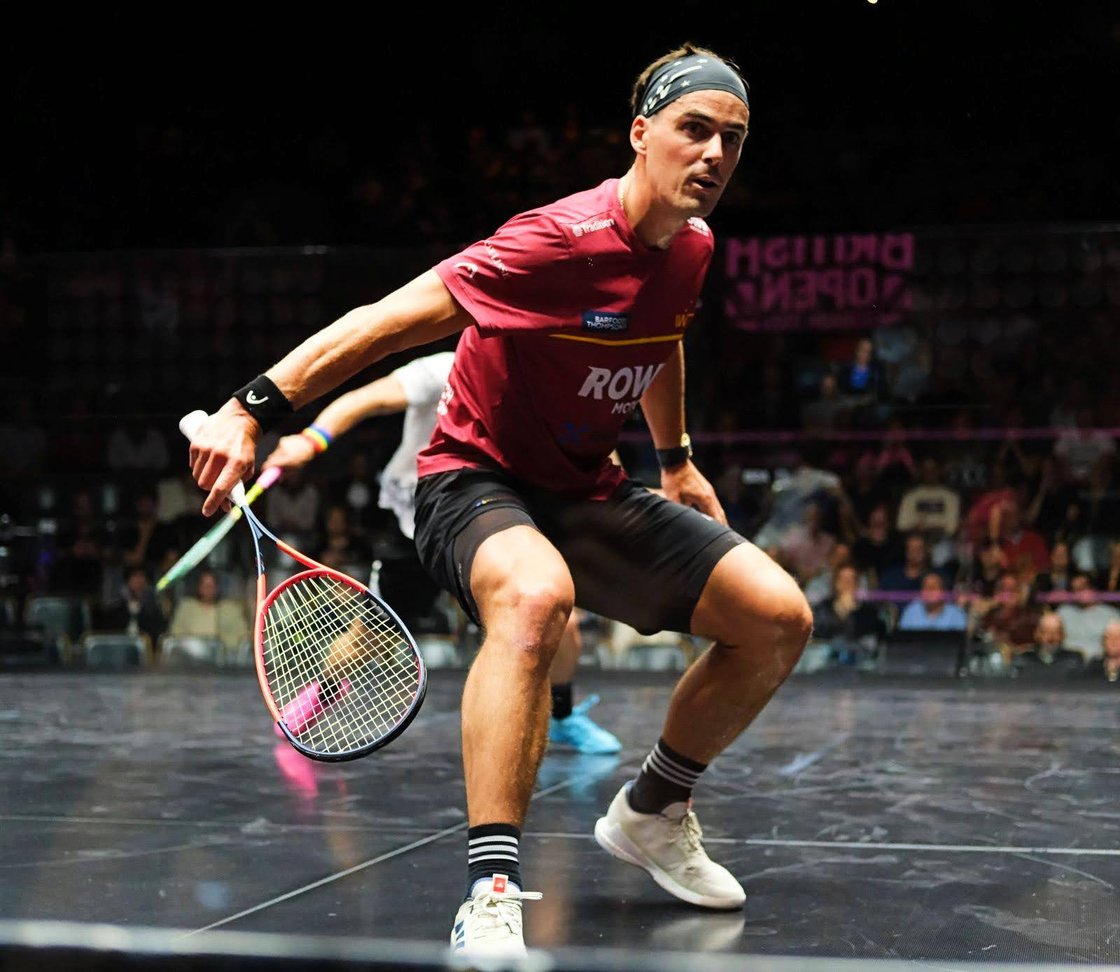
Image credit: Steve Cubbins
How to Experiment With Tension Properly
After speaking to some of my squash friends who play to a very high standard, it seems like tension almost becomes a bit of an identity for them.
Once they know what they like and what best assists their style of play, they'll stick to that and play the way it helps them play.
To an extent, string tension can reflect how you think about squash, how you approach rallies, and how you deal with pressure.
If you like to dominate with pace, you’ll naturally gravitate to lower tensions.
If you like to sculpt rallies carefully, you’ll feel more at home at higher tensions.
If you like adaptability, the middle ground usually feels best.
Your tension choice shouldn't be random, that's one thing I now know.
But it's not like we snap our strings every week, and it would be very expensive to just keep changing them until you find what's right.
Unfortunately, this is a longer-term process of procuring and adapting.
This can be where many players go wrong.
If you jump from 28lbs down to 22lbs, hate it, and swear you'll never deviate again, then you may not figure out that you prefer it at 25lbs or 26lbs.
Tension isn’t something you experiment with in huge jumps.
The best way?
Adjust in small steps, 1 or 2 lbs at a time.
Chances are, you'll get used to it fast, and it won't impact your game in a major way (like a larger jump might).
Then, if you don't really like it, you'll still be able to play with your racquet, but you'll know for next time they snap to adjust the tension again.
Another thing is that styles can change over the years, too.
Perhaps you'll gain a bit of strength and explosivity and want to start attacking with a bit more power while taking balls earlier, but you may have had a high string tension up until now, which may be a sign to change too!
Only you know what feels best for yourself, and you've got the freedom to figure out what tension suits your game and feels right.
Other Factors That Influence String Feel
As I mentioned, Paul Coll has been known to use HEAD's Adaptive Fanned Pattern in his racquets, which means a more dense string pattern.
This is something that's often geared more towards control, whereas a more open stringbed may further enhance that trampoline effect that players who like to hit hard prefer.
So yes, string pattern can be one of the main factors (aside from tension) that influences how your strings feel.
There are some dense options, such as 16x19 (mains and crosses) for those looking for control over the ball, or there are more open options, such as 12x17 for players looking for a bit more of a pop.
String pattern can be something that you combine with your tension to further enhance the benefit, or you can use different options to tailor your racquet to access a blend of control and power.
But pthe attern is only part of the story. The type of string you use has just as much influence on feel.
Very briefly:
- Synthetic gut is the classic all-round option: comfortable, affordable, and suitable for most players.
- Polyester/monofilament strings are stiffer and more durable, great for big hitters who want control and consistency.
- Multifilament strings offer a softer, more powerful, more comfortable feel, but they do wear out faster.
- Natural gut (rare in squash) is the softest and most powerful, but also the least durable and most expensive.
The gauge (i.e. thickness) of your string can have a decent amount of influence on how your racquet feels and performs.
Most squash or racquet strings you see will come in gauges like 18 (thinner), 17 (thicker), and 16 (even thicker), if it’s a heavier string.
Thicker strings (lower gauge number, e.g. 16-17G) usually lead to more control, better durability, and a firmer, more stable feel.
Thinner strings (higher gauge number, e.g. 17-18G) tend to provide more feel and power, livelier response, and have slightly more “give” and bounce, but they can break or lose tension sooner.
So when you choose your string gauge, you’re really deciding whether you want your racquet to feel stable and predictable, or lively, energetic, and powerful.
Combined with tension and pattern, gauge gives you a huge amount of control over how your racquet behaves.
Final Thoughts
If you take one thing from this newsletter, just remember that tension shouldn't be a technical afterthought.
It can be a meaningful personal choice that shapes your feel, your confidence, and your performance.
You don’t need to obsess over numbers like a professional stringer, but it is worth spending some time figuring out where you sit on the tension spectrum.
Also, speak to the person who does your strings, as they'll be an expert in the field and able to help you with any further questions you might have.
If you haven’t experimented in a while, try adjusting up or down a couple of pounds and see how your gameplay responds
It might take months or even years to fully understand how you like your setup, and that’s completely fine.
Every slight tweak helps you learn more about your game, your strengths, your preferences, and your playing identity.
This article was taken from our On The 'T' Newsletter, if you're interested in receiving more content like this, please feel free to sign up using the subscribe section located at the bottom left of this page (or underneath the article if you're on mobile), thanks!


